 Your Personal AI
Your Personal AI
Your Personal AI
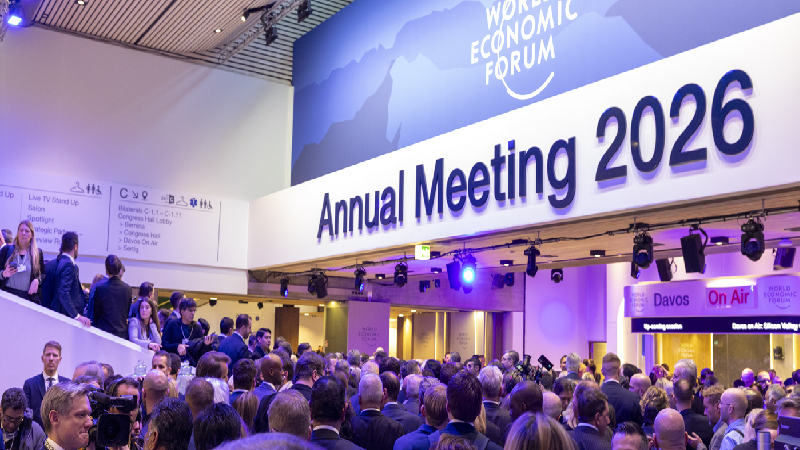
The World Economic Forum’s Davos 2026 recap “4 takeaways from Davos 2026” highlighted how AI permeated the week’s most urgent discussions — spanning workforce disruption, equitable access (“diffusion”), governance guardrails, and the societal and psychological effects of AI at scale.
AI and jobs: IMF Managing Director Kristalina Georgieva warned that AI will impact a large share of global jobs in the near term (including significant impact in advanced economies). She also cited the IMF’s own internal shift (a sharp reduction in translators) as an example of real-world labor transformation already underway.
Diffusion and access: Leaders emphasized that AI’s power depends on broad accessibility, not just frontier capability. Saudi Arabia’s Khalid Al-Falih argued diffusion must happen globally, while NVIDIA CEO Jensen Huang expressed optimism that AI can help close the technology divide — if benefits are distributed widely.
Guardrails and outcomes: Tech and services leaders stressed that AI should amplify human potential rather than eliminate work. Microsoft CEO Satya Nadella argued AI should be used to improve real outcomes for people and communities, while Accenture CEO Julie Sweet framed the shift as “human in the lead,” signaling a governance posture beyond “human-in-the-loop” compliance.
Children, cognition, and humanity: Speakers raised concern that AI shortcuts could erode the cognitive skill-building children need to thrive. Becky Kennedy (Good Inside) argued children may not develop essential skills if learning is “downgraded” by AI convenience, while Jonathan Haidt warned of escalating harms as platforms move from attention manipulation toward deeper social and emotional influence.
Hybrid human–AI society: In the “Living the questions” theme, historian Yuval Noah Harari argued there is no precedent for building a hybrid human–AI society, calling for self-correcting mechanisms so wrong bets are reversible — framing AI governance as societal systems design, not only technical safety.
Why it matters: Davos is increasingly treating AI as a civilization-level variable — simultaneously an economic transformer, a diffusion and equity challenge, a governance problem, and a human development risk. The highest-signal theme is shifting from “model capability” to “societal integration under guardrails.”