 Your Personal AI
Your Personal AI
Your Personal AI
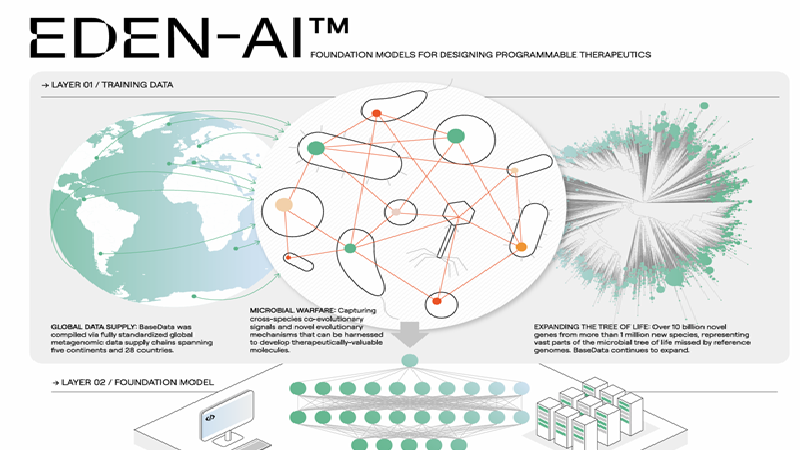
UK-based startup Basecamp Research has introduced EDEN, a new family of AI foundation models developed in collaboration with Nvidia and trained on evolutionary DNA data spanning more than one million species.
The EDEN models learned from genetic data collected across 28 countries, studying how organisms evolved biological solutions over billions of years. Basecamp says this evolutionary grounding allows the models to design novel therapeutic approaches rather than simply optimizing existing ones.
In early lab tests, EDEN-designed gene-editing tools were able to insert therapeutic DNA without cutting it, a potentially safer alternative to approaches like CRISPR. In disease models such as muscular dystrophy and hemophilia, over 63% of AI-designed treatments were reported as functional.
The research also produced new antibiotic candidates, with 97% proving effective against dangerous drug-resistant bacteria, highlighting EDEN’s potential role in addressing the growing global crisis of antimicrobial resistance.
Why it matters: Drug discovery is slow, expensive, and often reactive. By teaching AI to learn directly from billions of years of evolution, Basecamp Research is betting that medicine discovery can become faster, more programmable, and better equipped to tackle genetic diseases and antibiotic-resistant infections that current drugs struggle to address.