 Your Personal AI
Your Personal AI
Your Personal AI
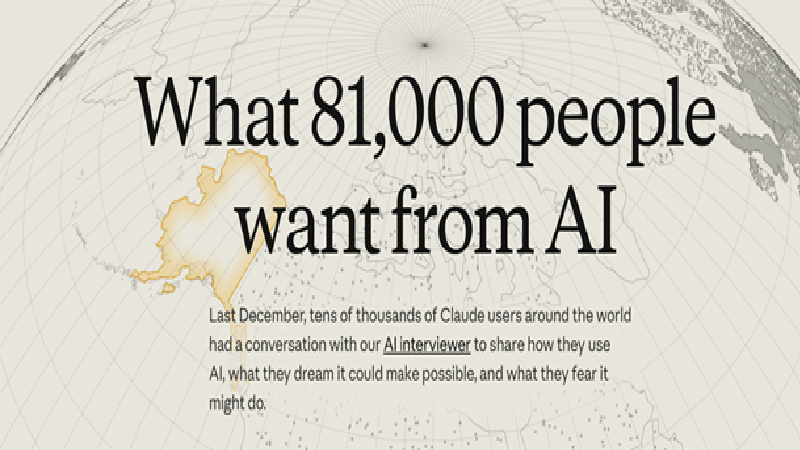
Anthropic has published a new qualitative research project based on open-ended interviews with 80,508 Claude users from around the world. Rather than analyzing benchmark performance or enterprise usage, the project asked people directly how they use AI, what they hope it could make possible, and what they fear it might do.
According to the official feature from Anthropic, the interviews were conducted over one week in December using an AI interviewer based on Claude. Anthropic says participants came from 159 countries and responded in 70 languages, making it what the company believes is the largest and most multilingual qualitative study of its kind.
Anthropic says hope and concern often coexisted within the same person. Many participants described AI as already helping with work, learning, caregiving, health, and entrepreneurship, while also voicing fears about job loss, overdependence, and the broader societal consequences of systems that may become more capable than humans.
The company also says 81% of respondents reported that AI had already taken at least one step toward the future they hoped for, suggesting that many users do not see AI only as a future technology, but as something already shaping daily life.
Most public discussion around AI still centers on abstract debates about risk, regulation, and capability. This project is notable because it captures what everyday users themselves say they want from AI in their own words, at unusually large scale and across many countries.
For the broader AI industry, the findings offer a more human-centered view of adoption: people are not only asking for faster work, but also for more time, less mental burden, better learning, improved health, and greater economic opportunity.