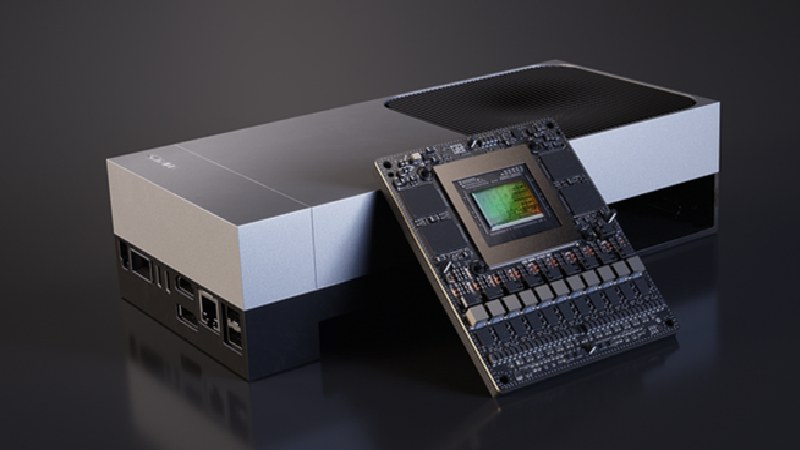
NVIDIA has officially announced the availability of its Blackwell-powered **Jetson Thor**, a next-generation computing platform designed to accelerate the age of general-purpose robotics.
According to the company’s press release
NVIDIA Newsroom, Jetson Thor brings unprecedented compute power to robots of all scales — from autonomous machines in factories to humanoid service robots and edge AI systems.
At the heart of Jetson Thor is the NVIDIA Blackwell architecture, delivering over a petaflop of performance for AI workloads in a power-efficient form factor.
This allows developers to run advanced multimodal models, enabling robots not only to process visual and speech inputs but also to reason and make decisions in real time.
NVIDIA has integrated safety, security, and low-latency communication features to support robotics in critical environments, including manufacturing, logistics, healthcare, and household applications.
The platform is paired with NVIDIA’s robotics software stack, including the **Isaac robotics platform**, Omniverse for simulation and digital twins, and CUDA acceleration for AI model training and deployment.
Together, these tools provide an end-to-end pipeline for robotics development, from virtual prototyping to real-world deployment.
Why it matters: Robotics has long promised to reshape industries, but limited computing power and energy efficiency bottlenecks have slowed progress.
Jetson Thor aims to overcome these barriers by offering scalable performance in a compact design, giving roboticists the ability to deploy AI models once reserved for data centers directly into robots on the edge.
This unlocks use cases such as humanoid robots capable of natural interactions, autonomous warehouse systems that can adapt in dynamic conditions, and collaborative industrial robots that work safely alongside humans.
Market analysts suggest that the release of Jetson Thor could mark a turning point for robotics adoption, especially as labor shortages and automation demands continue to rise globally.
By lowering the barrier to deploying advanced AI in physical systems, NVIDIA is positioning itself as a central player in the robotics revolution.
The company emphasizes that Jetson Thor is not just a hardware launch but a step toward “general robotics,” where AI-driven machines can perform a wide variety of tasks across industries and homes.
 Your Personal AI