 Your Personal AI
Your Personal AI
Your Personal AI
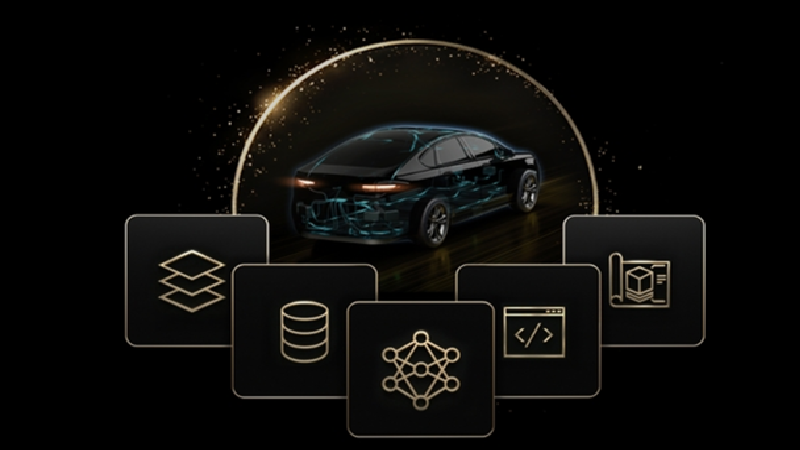
At CES 2026, NVIDIA unveiled Alpamayo, a new family of open-source AI models and tools designed to help autonomous vehicles reason through difficult, rare, and safety-critical driving situations. The company positions Alpamayo as a step toward “reasoning-based” autonomy — where systems can explain decisions and handle scenarios beyond what they have seen during training.
The key technical shift is the use of chain-of-thought, reasoning-capable vision-language-action (VLA) models. Instead of relying only on separate perception and planning modules, the Alpamayo approach aims to reason about cause-and-effect in complex environments — especially the “long tail” of unusual edge cases that are hard to capture in training data and often determine real-world safety outcomes.
NVIDIA is releasing Alpamayo 1, a 10B-parameter model that takes video input and generates driving trajectories alongside reasoning traces, showing the logic behind decisions. NVIDIA describes Alpamayo models as “teacher” models — not necessarily intended to run directly in-car, but to help teams fine-tune, distill, and build smaller runtime models that can power production AV stacks more safely and transparently.
Alongside the model, NVIDIA is open-sourcing AlpaSim, an end-to-end simulation framework for closed-loop testing, plus “Physical AI Open Datasets” hosted via Hugging Face that include 1,700+ hours of real-world driving across diverse geographies and conditions. Together, NVIDIA frames these as a full development loop: build → simulate → evaluate → refine, with better coverage of rare scenarios and improved explainability.
Why it matters: if open reasoning models and open evaluation pipelines become common building blocks, they could lower the barrier for automakers and researchers to validate safety at scale — and accelerate progress toward robust Level 4 deployments. NVIDIA also emphasizes that the approach is underpinned by its NVIDIA Halos safety system and is intended to help the industry build trust through explainable, testable autonomy.